Case study · Space domain awareness
OrbitSentrytracked, and honest about it.
A browser console that tracks a curated satellite catalogue and screens it for close approaches, manoeuvres and reentries — built so that every number it shows can be defended.
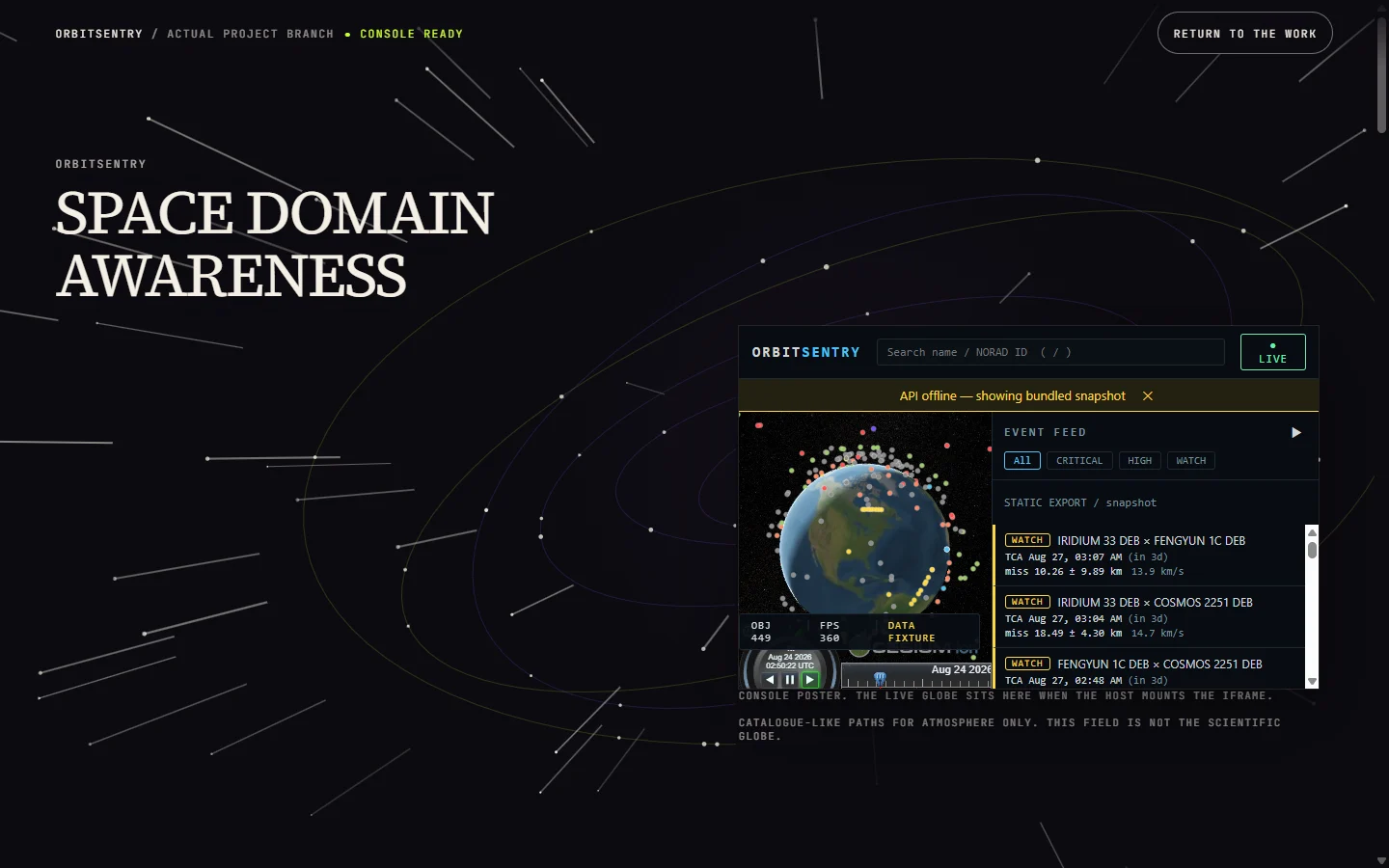
Actual console · bundled 449-object public catalogue · API-offline snapshot shown
01What it proves
Domain research, tested orbital mathematics, and the discipline to show uncertainty instead of hiding it. Public orbital elements do not carry covariance — a naive tracker can render precise-looking positions and close-approach numbers that simply are not precise.
02How it stays honest
- Positions carry the age of the element set they came from — stale objects visibly degrade instead of rendering confidently wrong.
- Conjunctions report miss distance with an uncertainty band, never a naked number.
- Derived events are labelled as this project's own analysis, not as official products.
03Evidence
Propagation is unit-tested against the official AIAA SGP4 verification vectors at 1 mm tolerance — the maths is checked against a known-good reference rather than trusted because a package imported successfully.